The Alexandrian

WITH JUSTIN ALEXANDER, PANAVIOTIS LINES, AND ALED LAWLOR

Today, we’ve got a four-way with Ben Riggs! Listen and marinate in the brilliance of Justin Alexander, Panayiotis Lines, & Aled Lawlor!

Aled Lawlor and Panayiotis Lines are the creative duo behind Leyline Press. In just a few short years, Leyline has carved out a reputation for distinctive, atmospheric RPGs that blend striking visual design with elegant, playable mechanics. This includes Salvage Union: Beautiful art, and delightfully mashes up mecha combat, exploration, and socialism. Aled and Panayiotis are reshaping what small-press tabletop games can look and feel like.

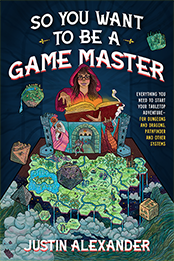
And then we’re thrilled to welcome a name familiar to just about every GM who’s ever looked for deeper insight into the craft, a man whose influence on the culture of TTRPGs is hard to overstate, the human responsible for the Alexandrian, Justin Alexander. His essays, reviews, and innovative techniques, such as like the “Three Clue Rule,” have become touchstones in modern RPG discourse. His book, So You Want to Be a Game Master, is absolutely outstanding and has been read by I think four different tweens in my classroom.

Watch now on Youtube!

Picture of a magnifying glass lying atop file folders

What do you do with your character sheets between game sessions?

If you’re using an online service for your character sheets that everyone in the group can access, this will largely take care of itself. But if not, then this is one of those little technical flourishes that you probably never think about, but which can nevertheless have an impact on your game. (And particularly so with some RPGs.)

Broadly speaking, there are three competing interests when it comes to the disposition of your group’s character sheets.

First, and most importantly, the players need to have their sheets during the game. (Obviously.) So if they forget to bring them or, worse yet, lose them entirely, that can derail an entire session.

Second, between sessions, the GM may want to reference the PCs’ sheets while prepping adventures. (Is anyone proficient in a particular skill? What spells do they have prepared today? Who’s carrying the Eye of Miebalung? And so forth.)

Third, and this is where it gets tricky, the players may want to have access to their sheets between sessions. This will be particularly true if they need to advance their characters between sessions or if there’s any form of intersession play. (For example, some groups might run domain play or downtime actions on their Discord server.)

Laying out all of these competing interests like this, it’s easy to see the points of tension.  In fact, if we assume there’s just one copy of each sheet, it would seem impossible to satisfy everyone’s needs, although whether or not this will effect a particular group will depend on their personal tastes and predilections.

(For example, I mostly prep my scenarios while thinking about the “logic of the world,” so I rarely, if ever, design with the PCs’ characters sheets in mind. In other words, I set up problems and let the players worry about how their characters will solve them. Although there are exceptions, like how the GUMSHOE system spreads its Investigation Abilities between the PCs, and it can be useful to do some spot-checking to make sure everyone is getting access to the spotlight.)

MY SOLUTIONS

In my dedicated tables, my players usually keep their sheets, taking them home with them between sessions. (Many of my players are copious note-takers, and they’ll often have a fistful of handouts they’ve collected over the course of the campaign. So they’ll just keep all that stuff together, sometimes even reviewing it between sessions.)

However, I do make a point of periodically making a copy of their sheets. (This usually just means taking pictures of them with my phone, although if the players are using a digital sheet – e.g., form-fillable PDFs – I’ll just have them e-mail me copies.) I generally don’t do this after every session (too much hassle), but instead aim for the moments where the sheets have been significantly updated. In D&D, for example, I try to remember to do this each time the characters level up. In my Night’s Black Agents campaign, on the other hand, I’ll do it after each major operation (which is, again, when character advancement is happening).

This works well because my copy is generally up to date enough to be an effective reference for adventure prep when I need it. If a player forgets their sheet for a session, it’s also “good enough” (or, at least, close enough) that I can print temp copies for them.

For my open tables, on the other hand, I’ve defaulted to keeping all of the character sheets. I’ve discovered that the more casual nature of the game and/or the long breaks between sessions for some players meant that it was much more likely for character sheets to vanish into the ether if they left the table. For open tables I’m also usually running RPGs with streamlined character creation systems, so players also don’t need as much time to advance their characters and are unlikely to be doing it between sessions.

OTHER SOLUTIONS

This is a good example of how the specific needs of your group may shift from one campaign and game to the next. So what you want to do is keep the general principles in mind, while thinking about how they can be fulfilled and the tensions between them resolved in each specific case.

For example, if the game is being hosted at the apartment of one of the players, it may make sense for that specific player – rather than the GM – to keep all of the primary character sheets. (If they never leave the gaming room, they can never be forgotten.)

As another example, the GUMSHOE roleplaying games all include worksheets that GMs can use to specifically track the Investigative Abilities of the group. By capturing the essential information the GM is most likely to need while prepping adventures between sessions, a tool like this may reduce the GM’s need to make duplicates of the PCs’ sheets.

Similarly, the digital tools I mentioned earlier can almost automatically resolve these issues by making access to the character sheets ubiquitous and the number of copies functionally infinite. But this can create tradeoffs for players who would prefer to play with paper-and-pencil (how often are they required to update their digital sheets? how can printing off up-to-date copies for each session be facilitated?) and potentially raise other questions. (For example, what will you do if an online service goes offline? Do you want to archive older versions of the sheets? If so, how often should you do it?)

There are undoubtedly solutions and creative approaches to this stuff that haven’t even been discovered yet. So keep experimenting!

Airlock - James Floyd Kelly

Go to Part 1

Airlock is a series of systemless SF horror adventures created by James Floyd Kelly. I grabbed the first four in the series with an eye towards using them in my Mothership campaign.

All of the adventures in the series are two-page trifolds. The presentation is fairly standardized and they’re all designed with white text on a black, star-speckled background. The result is evocative, but not very friendly on the printer ink. (I actually jumped through some hoops to invert the files before printing them.)

(You may notice that the Mothership logo appears on the cover images for these adventures on DriveThruRPG, but they are definitely systemless and do not use Mothership’s mechanics.)

AIRLOCK #1: THE SIGNAL

The PCs are sent to pick up two data technicians from an isolated, long-term data vault being run by the Kars-Sundar corporation. When they arrive, however, they find one of the techs dead and the android survivor acting erratically. If the PCs investigate, they’ll likely discover that Abbi, the android, was corrupted by a distress call received by the station.

The concept is straightforward enough that you should be able to hack a playable experience out of this one, but The Signal is near-fatally flawed by it continuity being all over the place:

  • Kars-Sundar is shutting down the long-term data vault… except then it isn’t any more.
  • When the PCs find Abbi alive and Steven missing, Abbi tells them her fake story of what happened… unless it’s a significantly different fake story that’s only implied elsewhere in the adventure?
  • As the crew arrives, a radiation storm will knock out the comms and prevent Abbi from exposing them to the Signal… but also she plays it for them when she first meets them.
  • Is Abbi’s goal to reach the origin point of the Signal or is it just being randomly destructive and murder-y?

This adventure is supposed to have a direct connection to Airlock #2: Distress Call (which ostensibly takes place at the location where the Signal originated), but it turns out this just creates even more weird continuity glitches.

I’d like to say that all of this makes The Signal a kind of grab bag that a GM could pick elements from build their own version of the adventure. But it’s really just a vague, barely usable mess that becomes more confusing the more time you spend trying to unravel it.

What I want from an adventure – whether one I buy or one I prep myself – is rock solid continuity. I want to know exactly what the situation is, so that we can then inject the PCs into that situation and play to find out the result. So this one misses the mark pretty wide for me.

GRADE: D

AIRLOCK #2: DISTRESS CALL

Following some dubious experiments, the AI core of the Fractal Dream has taken over the ship and killed the crew. Unfortunately, this leaves the AI stuck in space, so it sends out a distress signal to lure in some suckers (i.e., the PCs). Now Katie, the AI, needs to take over the PCs’ ship so that it can escape.

…which would make sense if the crew of the Fractal Dream had managed to disable the ship’s engines before Katie took over. But they didn’t. Instead, shutting down the engine is something the PCs are expected to do.

Maybe the intention here is that Katie is just pretending to be stranded to lure in the unwary? But this would seem to contradict other sections of the text and it’s all very vague. In fact, the biggest problem here is that a lot of Distress Call is just waving generally in the direction of an adventure.

This also means that there’s a lot of blather on the page. For example, there’s four different paragraphs scattered around this two-page trifold, each explaining how Katie has broken free of her programming, is no longer bound by her safety restrictions, and so forth.

But because so much space is wasted on blather, it also means what should be the actual meat of the adventure is short-shrifted. For example, there’s a bit where Kelly writes, “Katie has plenty of offensive weapons – shocks via metal surfaces, electrical overloads, temperature control, and many more.” The adventure would be considerably better if a lot of its blather was placed with actually giving Kelly a concrete, fully realized toolset of fun, dynamic actions the GM could deploy in response to the players.

What’s here isn’t really a firm foundation that you could use to build a playable version of the adventure. It’s more like a quick sketch of what a blueprint of that foundation might look like.

Expect to put a lot of work into this one.

GRADE: D-

AIRLOCK #3: CRYO – SWEET SCREAMS

Cryo: Sweet Screams is a really frustrating adventure to use. (Or, at least, try to use.)

First, the scenario is incorrectly sequenced. There’s a section called “Running the Scenario” which is positioned, on the page, to seemingly be read last, but which has essential information necessary to understand large swaths of the rest of the adventure. But, upon closer inspection, it turns out that reading this section first won’t work, either: There’s no correct reading order here. It’s just a big jumble.

The scenario also promises the GM certain tools, only to fail to deliver on them. Take the “Cast of Characters,” for example. It would be super useful to have this authoritative reference for each character in the adventure,  but it turns out that every single character write-up lacks the essential information for the character (e.g., “she’s the bad guy”).

Once I untangled the adventure, though, what I discovered was something that seemed hopelessly overwrought:

The PCs are sent to intercept and redirect a medical intervention ship whose comms array has been damaged.

But that’s not all! The corporation is also reprogramming the ship’s android to get up to mischief, and that obviously goes awry and causes the android to start acting erratic (as androids are wont to do).

But that’s not all! The android isn’t the real bad guy. The real bad guy is the human member of the crew, who has ALSO been infected with a (biological) virus that makes her a psychopath.

Even if you want to roll with this “it’s viruses rewriting personalities all the way down” premise, though, Cryo: Sweet Screams has deeper issues.

The crux of the adventure is, “Durden will slowly exhibit strange behavior once he wakes.” But what is this strange behavior? No idea.

Later, if the PCs watch the news and learn that the vaccination program at the ship’s last stop was botched, “this news will trigger actions in Durden and Talisha.” What are these actions? No idea.

Furthermore, the medical ship’s shuttle “will have some issues that need to be addressed by the crew.” This is, in fact, stated no less than three times across the six panels of the adventure, and the idea is that this will give the PCs something to do while the unspecified “strange behaviors” are happening.

But what are these tasks the PCs are supposed to do?

No idea.

GRADE: F

AIRLOCK #4: DEAD WEIGHT

I’ve concluded, after reviewing dozens of these adventures, that the trifold format is a tricky one. Creators really don’t seem to understand how to organize their information. The front page is often used as if it’s back cover text (which is kind of waste of space in a format where space is quite limited), and then, once you flip open the trifold, it’s a complete crapshoot which order you’re supposed to read the other five panels in.

Some creators seem to have decided to just wave the white flag and simply not include any sort of orientation for the GM. For example, no matter where you begin reading Dead Weight, the text will always just blithely assume that you know what a GH3 is.

If you, too, are wondering what they are, after trawling the text and reassembling the scattered bits of information thrown around with wild abandon, I’m fairly certain the answer boils down to, “A large tribble with legs and teeth.” The GH3s breed incredibly rapidly, and will quickly overwhelm any station or ship they find themselves on, rending every bit of flesh they can find along the way.

As another example of the white flag being waved, take the NPC named Mitchell. In one section he’s been placed in cryosleep. In another, there’s an offhand comment to him “having his own programming.” From this, I assume you’re supposed to conclude that he’s an android, but the adventure never actually says that. There’s a lot of this kind of stuff scattered around the text, creating countless booby traps and lacunae.

Taking a step back, the scenario hook for Dead Weight is that the PCs detect an intermittent signal coming from an abandoned space station which has drifted into deep space. When they board the station to claim the salvage rights, they awaken the GH3s, which have survived in a state of advanced hibernation.

The core premise seems to be that the PCs will conclude that it’s impossible to kill the GH3s faster than the GH3s reproduce! They’ll have no choice but to flee and/or blow up the station!

… except the reality is that the GH3s double their numbers every 8 hours. That’s quite aggressive for a biosphere, but rather less terrifying to a PC with a flamethrower. (In contrast, an ochre jelly in D&D is terrifying because it can split multiple times per round. If it, like the GH3s, split once every 8 hours, it would be considerably less intimidating.)

In fact, this is another example where it’s difficult to understand how the time scale of this adventure is supposed to work at the table: What are the PC supposedly doing during the hours and hours of time the GH3s need to become a meaningful threat? This is something you might be able to solve by prepping some time-consuming guidelines for how long it takes to effectively salvage the station – e.g., repairing thrusters takes 4 hours, etc. – but you’re really swimming uphill at this point to force this adventure into a satisfying experience at the table.

GRADE: D

Note: This adventure should not be confused with Dead Weight, an unrelated Mothership adventure written by Norgad, which I previously reviewed.

CONCLUDING THOUGHTS

There are a lot of problems with these Airlock adventures, and they’re pretty consistent throughout the series. The impression I’m mostly left with is that all of them are more like the concept of an adventure, each remaining, sadly, undeveloped in any meaningful way while the poorly organized trifold format is instead filled with vague, often directionless and repetitive blather.

I was really hoping that these were going to be great. I was very excited when I found the series, which has almost a dozen installments. I thought I’d found something that would keep my Mothership open table supplied with adventures for potentially months.

Unfortunately, I found these first four installments to be essentially unusable and I’ve given up on the series.

Horde of the Undead

DISCUSSING
In the Shadow of the Spire – Session 48C: Entering the Tomb

Passing down a short flight of open stairs and through an antechamber of sorts, they entered another large chamber, this one with a wide pit in the center of it.

Carefully approaching the edge of the pit, Tee looked down to find it tightly packed with two dozen or more ancient zombies – their grey and desiccated flesh stretched cross across browned bones. When they became aware of their presence, the undead things began to claw wildly at the walls, although they found no purchase and there seemed little risk of their escape.

“Desiccated?” Agnarr said. “That sounds flammable.”

As the PCs reach what we now think of as Tier 2, you have the opportunity to start using certain monsters for effect rather than threat.

When they were 1st level, the PCs nervously peered in every direction, ready to leap into action at even the slightest hint of movement. They really had no choice: Even a rabid house cat might prematurely end their adventuring careers with a couple of unlucky dice rolls.

As you drift into higher levels, however, some of those early foes become so trivial that they no longer pose any meaningful threat, even in great numbers. Take, for example, the pit of zombies in this session. Even if one of the PCs had been thrown headlong into this shambling horde, they’d almost certainly have been okay: If they hadn’t torched them, Nasira could’ve turned them en masse. And if she hadn’t, then Agnarr could have easily cleaved his way through them.

As a GM, it’s easy to respond to this trivialization of challenge by simply eliminating such encounters. And, of course, to some extent, that exactly what you should do.

But what this ignores is that encounters can be – and should be! – about more than just combat challenges. If you’ve been conditioned to think of D&D as simply a string of combat encounters connected with a thin patina of exposition, this may seem strange. But encounters should also be serving the needs of mood, theme, logic, and world-building.

This particular pit is helping to set tone and show the history of the Tomb (the upper levels have been abandoned for a long, long time). It also reinforces theme and just generally creeps the players out. (It could have also been significant as a bargaining chip when the PCs went down to the second level of the dungeon, but (a) as we can see here, that never happened and (b) I no longer recall if that was intentional on my part when designing the dungeon or if it was just one of those happy accidents.)

Facing encounters that would have once been daunting but have instead become trivial also communicates something about the PCs’ changing place in the world. It’s also important to remember that, even though such encounters might pose little or no risk to the PCs, they can still be deadly dangers to their PCs’ allies and other NPCs in the dungeon (and showing that to the players can also be a great way of reinforcing everything they’ve gained through their hard work).

For example, maybe the PCs can cut a swath through the goblins on the top level of the dungeon with ease, but the presence of those goblins may nevertheless explain why the lizardfolk have been trapped down on the second level of the dungeon.

Undead, in particular, can have a lot of this worldbuilding potential. They can last a long time and continue communicating a lot about a dungeon’s original purpose and its history, either through their presence, their actions, or even just their clothing. And, in terms of challenge, there’s something deeply satisfying about watching foes that once intimidated you go scurrying away in terror after the cleric turns them.

You can take a lesson from that when running non-undead foes, too: You don’t need a divine gift for a mob of goblins to go scurrying for their hidey-holes after seeing the barbarian slice-and-dice their comrades by the dozen.

It feels great for the players, but can also present a fun twist where the trivial mooks raise the alarm and bring much dangerous foes into the fray.

Campaign Journal: Session 48D – Running the Campaign: Art Handouts
In the Shadow of the Spire: Index

Ptolus - In the Shadow of the Spire
IN THE SHADOW OF THE SPIRE

SESSION 48C: ENTERING THE TOMB

January 9th, 2010
The 26th Day of Kadal in the 790th Year of the Seyrunian Dynasty

Shadows

After perhaps fifty or sixty feet, Tee emerged into a small chamber of unadorned stone. The shadows seemed even deeper here, stubbornly clinging to the corner of the room.

There was a single door of iron. As Tee took her first cautious step off the stairs towards it, Elestra – following behind her – gasped to see the shadows literally dart out from the walls. Catching Tee unaware and from behind, the first shadow clawed its incorporeal hand through her shoulder while the other plunged its own straight through her heart and chest.

Tee gasped, fumbling for a potion to fight off the cloying cold gripping at her limbs. As she stumbled away from the stairs, the supernatural shadows pursued.

Agnarr raced down the stairs. Tor, who had been watching the party’s rear, pushed his way past Ranthir and the others still on the stairs, but couldn’t get past Agnarr without exposing his own back to the shadows.

Elestra, cut off by both of the fighters, instead turned into a bird, flew through a gap in the stone balustrades of the stair, and alighted by Tee’s side. With soothing hands, she helped her shaking friend.

Nasira grasped her holy symbol and raised it high. The nearest shadow fled from her faith, passing through the iron door. This allowed Agnarr to safely back away from the base of the stairs, giving room for both Tor and Nasira to descend.

As Nasira came, she called aloud the name of her goddess – “SAYL!” – and in a burst of holy light the remaining shadow was blasted back into the floor of the chamber. There it remained for a long moment – like a shadow imprinted without an owner – before it faded away into nothingness. The palling darkness of the chamber seemed to lift at its passing.

HAUNTED HALLS

Beyond the iron door was a long hall of dark grey stone that seemed to serve as a crossroads of sorts between four narrow arches. Web-encrusted skeletons lay slouched in a dozen shallow niches that lined the walls of the hall. Tee was taking no chances and stabbed the nearest of the skeletons through its exposed sternum. As she did so, the skeleton in the next niche lurched suddenly to its feet… and then stumbled and collapsed into a broken heap.

Tor and Agnarr did a quick sweep around the circumference of the hall, bashing each skeleton in turn (although they evoked no response from any of the others). Ranthir, inspecting the remnants of their bone-bashing, noted that the skeletons had been covered in small, detailed runes – arcane in nature, but drawn in an archaic style. Some of the runes appeared necromantic, but not all of them, and Ranthir was puzzled as to what their purpose had been.

Passing through one of the arches leading out of the hall, Tee found herself in a huge chamber. Dozens of chains dangled from the ceiling, each tipped with a vicious, serrated hook. On two or three of the hooks she could see skeletal remains hanging limply.

… and many of the chains were drifting slowly in the breeze of a room in which the air was perfectly still.

The effect was unnerving, and after quickly confirming that the room was otherwise empty they went through the arch on the opposite side of the hall. Passing down a short flight of open stairs and through an antechamber of sorts, they entered another large chamber, this one with a wide pit in the center of it.

Carefully approaching the edge of the pit, Tee looked down to find it tightly packed with two dozen or more ancient zombies – their grey and desiccated flesh stretched cross across browned bones. When they became aware of their presence, the undead things began to claw wildly at the walls, although they found no purchase and there seemed little risk of their escape.

“Desiccated?” Agnarr said. “That sounds flammable.”

Tee sprayed some oil into the pit and lit ‘em up. The party backed out of the chamber as it started to fill with thick, black smoke carrying the stench of burning flesh.

Running the Campaign: Undead for Effect – Campaign Journal: Session 48D
In the Shadow of the Spire: Index

Archives

Recent Posts

Recent Comments

Copyright © The Alexandrian. All rights reserved.