The Alexandrian

Deathbringer - Professor DM

Dan De Fazio’s Deathbringer has lunched its crowdfunding campaign on Backerkit!

Deathbringer is a brutal new tabletop RPG from Professor DM and Roll For Combat, crowned EN World’s Most Anticipated TTRPG of 2026. Fully compatible with Shadowdark and built to drop into any OSR system, Deathbringer delivers fast, savage combat where death isn’t the end — it’s part of the journey.

I’ve been looking forward to Deathbringer for a long time now, and so I was absolutely thrilled when Dan invited me to join the party! I’ll be writing an adventure for Deathbringer!

In fact, Professor Dungeon Master has summoned a dark conclave of amazing adventure writers:

  • Kelsey Dionne, creator of Shadowdark and winner of the 2024 ENNIE Awards, including Product of the Year, Best Game, Best Layout & Design, and Best Rules
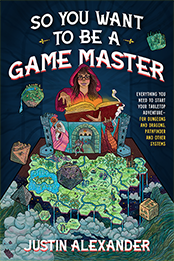
  • Justin Alexander, author of the USA TODAY Bestseller So You Want to Be a Game Master? and 2024 ENnie Gold Award Winner
  • Luke Stratton, creator of Pirate Borg
  • Brandon Gillam, founder of RPG publishing imprint RUNEHAMMER
  • Daniel Fox, creator of ZWEIHÄNDER Grim & Perilous RPG
  • Ben Milton, from Questing Beast, creator of Knave and Maze Rats
  • Baron DeRopp, Dungeon Masterpiece
  • Luke Hart, The DM Lair
  • Discourse Minis, Dungeons & Discourse
  • David McFarland, DM Scotty
  • William Tanner Schroeder, Paladin Prose
  • Grace “World Destroyer” Mason (the title is earned)
  • Bob World Builder

It’s an incredible honor to be invited to join these creators!

Combat is fast. Victories are earned. Death is real.

DEATHBRINGER

Atlas Games

Magical Kitties Save the Day, the game I co-designed with creator Matthew Hanson and Michelle Nephew, is being placed under an open license by Atlas Games!

Atlas asked me back to answer some questions about Magical Kitties, the open license, and what my plans are for the future.

Check out the full interview!

Magical Kitties Save the Day - Art by Ekaterina Kazartseva

Kihomenethoth - Monte Cook's Ptolus

And at his touch, the black oil of his thought passed from one mind unto the next until all served unto his image and his purpose. And where the Touched went, so the mind and might of Kihomenethoth followed.

This lorebook collects various pieces of knowledge regarding the Galchutt known as Kihomenethoth, the Writhing One.

THE ONE WHO SLEEPS APART: In many of the texts, Kihomenethoth is referred to as the “One Who Sleeps Apart” – “not banished from the Throne of Shadow”, but “choosing to remain separate from his kin, beneath the ancient Crypt of All Crypts, where he might be succored by the souls of winter”. He is also referred to as the “Lost and Living Idol”.

THE TENDRILS OF THE MIND: Kihomenethoth is written of as the most passive of the Galchutt. “He goes not forth to work his feats, but lets his Chosen come to him, so that they might be blessed with his Touch.”

Those who are touched by the “tendrils of its thought” become “as one with the great god”, “extensions of his will left to writhe through the world”. Through these thralls “he can see with many eyes and hear with many ears”. And Kihomenethoth “shall breathe the air they shall breathe and walk where they walk”.

THE SUMMONS OF THE DISSOLUTION: “And on the night when the bonds of all bonds are broken, they shall hear the call of their Master and their footsteps shall guide them to the Path of Chaos.”

DESIGN NOTES

This lorebook is a little on the short side because, if I recall correctly, I had to write it up at the very last moment, just a few minutes before the start of a session. It was originally keyed to The Laboratory of the Beast, and then later added to The Vladaam Affair as well.

Back to Chaos Lorebooks

A1 Slave Pits of the Undercity - TSR, Inc.

The A-series of modules were classics back in the day… But do they have anything to offer to the modern gamer?

Originally Published March 16th, 2002

The A-series of modules was released in 1980 and 1981. Also known as the Slavers series, the Slave Lords series, and the Scourge of the Slavelords (after the omnibus edition released by TSR in the mid-‘80s), it comprised four modules: A1: Slave Pits of the Undercity, A2: Secret of the Slavers Stockade, A3: Assault on the Aerie of the Slave Lords, and A4: In the Dungeons of the Slave Lords. The modules were originally used for the AD&D Tournament at GenCon XIII, and evidence of that remains (in the form of a complete tournament scoring system as well as the design of the adventures themselves – although a few token efforts have been made to make them more flexible). The entire series is currently available in electronic form through Wizard’s website.

These modules are industry classics. By modern standards, of course, the primitive artwork of Jeff Dee (and others) is almost laughable; and the sparse, almost constrained presentation of the material by David Cook (later famous for his work as the primary designer on the second edition of AD&D) little more than quaint.

But as classics they demand our attention: There is a reason these modules earned a reputation for greatness in the gaming community. Whether that bygone glory rests upon a foundation which is still worthy of your consideration today is something this review is going to take a closer look at.

CONCEPT

Warning: This review will contain spoilers for the A-series of modules. Players who may find themselves playing in these adventures should not read beyond this point.

The entire A-series of modules is based around a central conceit: A far-flung network of slavers has been founded, guided by the mysterious conspiracy of the Slave Lords. Finally, the local nobility – spurred on by the recent burning and looting of coastal towns by the slavers – have set aside their own petty differences to take collective action… Enter the PCs.

A1: Slave Pits of the Undercity sets the adventurers down outside a ruined temple compound. (Remember that these modules were originally designed for four rounds of tournament play. As a result, their use in an actual campaign will generally require the DM to fill in all of the details which surround the actual dungeon crawls themselves.) The interior of this temple compound was largely gutted by fire many years ago, but is now being used by the local slaver sect as a base of operations – or, more accurately, the access point for their base of operations.

The PCs need to fight their way through the compound to gain access to the sewers beneath it. There they will most likely need to make their way through a colony of aspis (a variety of giant insect) before entering the underground slave pens. Once they’ve found the pens, the PCs need to free the slaves and kill the local Slave Lord.

WEAKNESSES

Let’s start with the weaknesses.

First, there is a major flub in the design of the temple compound: As far as I can tell, there is absolutely no way to get from the left half of the compound to the right half of the compound. The very first thing you should do before running this adventure is figuring out where you want to insert a doorway. (I’d suggest a gateway leading through the wall from Area 9 to Area 16A.)

Second, the aspis encounters don’t make any sense: Why would the slavers build their slave pens here, where the aspis pose a potential threat? Why wouldn’t the slavers drive these creatures out? And why is there a tunnel leading from the aspis hive straight to the underground office of the local Slave Lord?

Third, I must confess that I have little tolerance for the Gygaxian style of adventure design in which the entire game world has been structured into a giant puzzle which the PCs must solve. As written, this module plays like an old Infocom text adventure game: Enter room 5A. Pick up barrel of stale vinegar. Go to room 5B. Throw vinegar at glue-like creature in 5B.

STRENGTHS

All that being said, A1: Slave Pits of the Undercity gives you a rock solid foundation. The scenario is engaging; the structure is sound; the maps are well done; the descriptive text is evocative; the character concepts have a lot of potential; and the encounters are generally memorable and of high quality. There are a few caveats here and there, but once you’ve stripped out some of the silliness which lurks in the corners Slave Pits of the Undercity is a great little adventure.

CONCLUSION

Despite its weaknesses, it’s actually trivial to modify A1: Slave Pits of the Undercity into a highly enjoyable adventure. Here’s the few quick steps I followed:

1. As detailed above, I added a gateway between Area 9 and Area 16A (so that the two halves of the compound were no longer segregated.)

2. I removed the aspis tunnels (and the aspis) entirely from the adventure. Their loss was barely felt. In the same vein, I also removed the goblin caverns in the sewers, too. This requires some remapping, but results in a far more utilitarian (and logical) slaver base in the sewers.

3. The Gygaxian puzzles are removed. Just plain removed. The sundew in Area 5B (the glue-like creature mentioned above) becomes a tendriculus, set there specifically to guard against unauthorized access to the temple compound. Beyond that, some basic logic and sense was applied to the slaver activities throughout the entire compound.

4. I also removed the silliness of automated slave pens with remote-control doors. Your mileage may vary, but that type of thing has always been an atmosphere killer for me.

For those looking to adapt these adventures to a D&D3 campaign, the process can be relatively simple or extremely difficult, depending on which approach you take. In general, once you’ve gotten rid of the aspis and the sundew, all of the monsters in Slave Pits of the Undercity can be found in the Monster Manual — simply grab the stats from there (and redesign the NPCs using D&D3 classes) and you’re ready to go.

Of course, if you’re looking to balance the adventure according to the principles described in the DMG, things become slightly more difficult. Fortunately, its relatively easy to make this module fit just about any desired level by modifying the number of creatures in an encounter and/or giving them additional class levels.

So what’s the final word here? Is this worth it?

Yes.

No doubt about it. This is a diamond in the rough, and it may take a little bit of work on your part to clean it up and present it in its best light – but once you do, you’ll have a real jewel on your hands.

Style: 2
Substance: 4

Author: David Cook
Publisher: TSR, Inc.
Price: $4.99
ISBN: 0-935696-25-3
Product Code: TSR9039
Pages: 24
Year Published: 1980

My disparagement of Jeff Dee’s art in A1 will likely be met with great outrage from some, but while Dee matured into a truly great artist, I think anyone honestly looking at this work in 1980 would have to concede he had not yet reached the height of his skills. (Although the raw creativity and fantastical cleverness of his compositions — along with the technical detail of his backgrounds — was already evident. Take, for example, the cover of A1: Not only the halfling clinging to the ceiling, but the multi-limbed fighting techniques of the aspis.)

Next: A2 Secret of the Slavers Stockade

For an explanation of where these reviews came from and why you can no longer find them at RPGNet, click here.

In his mouth the silent scream of the universal spirit became a siren of endless torment. His body was broken upon the rack of the many worlds. In that moment he became as nothing, and nothing became as him.

This tome records the lore of the Dhar Rhyth, one of the Galchutt.

According to the Lore of the Atapi – copied and translated from cuneiform shards – there is a hole in the fabric of this world. “Beyond the borders of this many-hole” lies the “broken realm of befanged worms”.

The hole acts like a portal, leading to a place filled only with squirming, worm-like creatures of utter horror. But these creatures are not the Dhar Rhyth – the Dhar Rhyth is the hole itself.

Dhar Rhyth

THE ENDING WITHOUT END: One myth tells that the Dhar Rhyth was once a man – a man who welcomed himself into a moment of annihilation, only to find the “existence beyond ending”. He became a personification of nullification – a broken, jagged gap between all things.

Many myths of the Dhar Rhyth, however, do not speak of such things. (Or perhaps merely do not see them in the same light.) The Dhar Rhyth is the antithesis of genesis – it has no beginning and no end. It is like the ouroboros inverted.

THE MANY OF THE ONE: “Dhar Ryth” is both noun and verb; name and genus; identity and property. There are those who believe that there is only one Dhar Rhyth in all of time. Others tell of the “times of congregation” in which more than one of the creatures has been seen at once. But then still others speak of “the fractured mirror which is yet whole”.

THE HOLE WITH NO EDGES: The very purpose of the Dhar Rhyth is annihilation and cultists who follow in its path speak of the “hole with no edges” – that all creation is like a hole with no boundaries; a nothingness with no substance.

THE HERALD OF THE SHADOW: Dhar Rhyth is often seen as the Herald of Shallamoth Kindred, another of the Galchutt. They are also known as the Harbingers of Chaos and Annihilation.

THE GATES OF CHAOS: As sentient holes in the universe, dhar rhythm can alter the connection between spaces. Through their nonexistent forms, they can serve as mobile gateways or summon to them all manner of things and beings.

Some texts speak of great temples of chaos raised above the motionless Dhar Rhyth – temples which last only until the Dhar Rhyth is suddenly given unto action, destroying and killing all those who surround it.

DESIGN NOTES

The Atapi referenced here are a desert nomad culture from the Southern Wastes which replaced the Viking-like barbarians in my version of The Night of Dissolution.

You can also compare this lorebook with The Worm of the Void, which details a cult dedicated to Dhar Rhyth. The two are designed to complement each other, regardless of which order the PCs discover them in.

Back to Chaos Lorebooks

Archives

Recent Posts

Recent Comments

Copyright © The Alexandrian. All rights reserved.